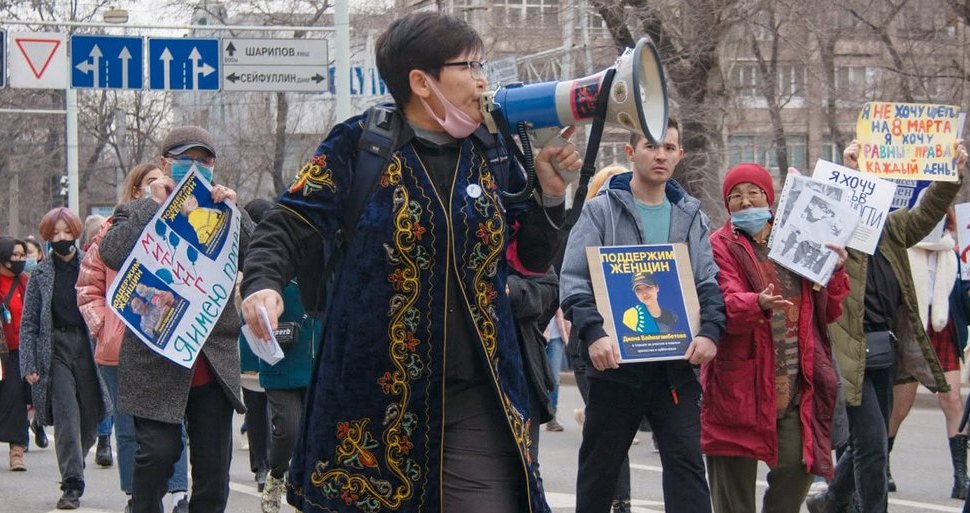
On August 25, three feminist activists were summoned for questioning at the Police Department in connection to their podcast, marking the authorities’ first attempt to apply the law against “LGBT propaganda” in practice.
Gulzada Serzhan is a human rights activist and the cofounder of the Kazahkstan Feminist Initiative ‘Feminita’, working to protect the rights of women from the most oppressed groups in Kazakhstan, namely queer and trans women, women with disabilities to women engaged in sex work.
On August 25, Serzhan and two other feminist activists were summoned for “questioning” at the Police Department in Almaty.
An officer from the Organized Crime Division summoned them in connection with alleged “LGBT propaganda” in ‘Feminita’s ‘Ten Tershilik’ podcast, which Serzhan dedicated to issues of the environment, veganism, and matriarchy.
As noted on the “Feminity” Instagram page, the podcast was only available through a link.
After Gulzada Serjan provided her explanation on August 25, the women who recorded her podcast were “invited to an interview.”
The law banning “LGBT propaganda” entered into force in December 2025, restricting the exposition of “non-traditional sexual orientation”on social and public media, public spaces and online platforms. According to Yelnur Beisenbayev, former member of the Mazhilis – the Parliament’s lower chamber until July 2026, if being part of the LGBTQ+ community is not banned by this law, it forbids people to invite others to participate in or show support for the movement.
The Feminita page highlighted the danger of this amendment, stating that the organization “is concerned that the amendments adopted at the end of 2025, which directly discriminate against LGBTQ+ people, result in a witch hunt. Zhanar Sekerbayeva and Gulzada Serzhan, like other activists, have the right to give interviews, participate in podcasts, and share their opinions in any public space”.
UN experts already predicted with uncanny accuracy its risks in 2025, warning the Kazakhstani authorities that the adoption of these controversial amendments was unacceptable: “The bill banning so-called LGBT propaganda, currently under consideration by the Parliament of Kazakhstan, will reinforce stigma, restrict freedom of expression, and contradict international human rights obligations”.
Even before the adoption of the law against “LGBT propaganda” – which sparked a negative reaction all the way up to the UN level- Kazakhstan began zealously persecuting LGBTQ+ activists and human rights defenders who opposed the discriminatory amendments. In addition, under various pretexts, justice departments are refusing to allow participants in these initiatives to officially register their organizations.
In Almaty and Astana, several private events were disrupted by LGBTQ+ opponents with the full connivance of law enforcement agencies, which turned a blind eye to violations committed by provocateurs.
In late April, another co-founder of ‘Feminita’, Zhanar Sekerbayeva, was fined for “assaulting” Ziuar Zhumanova, one of the most vocal opponents of the LGBTQ+, who, with other women, “stormed into a café and used physical force, including against the waitstaff,” according to a post on queer.kz.
The “interrogation” of the feminists marked the authorities’ first attempt to apply the law against “LGBT propaganda” in practice.
The future projected by this law is obnoxious, as many activists fear a replica of the Russian scenario , where a similar law led to declaring non-traditional sexual orientation or gender identity as a form of extremism within a decade.