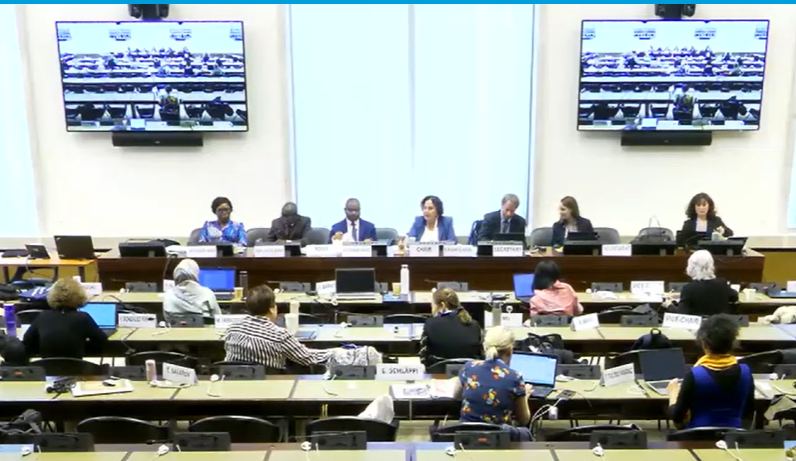
On October 6, 2026, in Geneva, at the 93rd session of the UN Committee on the Elimination of Discrimination against Women (CEDAW), the Government of the Republic of Kazakhstan presented its Sixth Periodic Report (CEDAW/C/KAZ/6). State bodies reported on how the country protects women’s rights, combats domestic violence and fulfills international obligations.
However, the actual discussion at the UN was heated, as Kazakhstan’s independent civil society has submitted a series of alternative reports to the Committee. Human rights defenders, lawyers, and experts exposed, through it, the vast gap between officials’ “polished” reports and the reality on the ground in the country.
Kazakhstan Sixth Periodic Report was presented on the second day of the session, during two meetings: one held in the morning (CEDAW’s 3010th meeting) and the second, in the afternoon (CEDAW’s 3011th meeting) . NGO representatives could attend the sessions as observers but were not able to take the floor.
At the beginning of the review, the head of the delegation, Yevgeniy Kochetov , was given the floor to present the report. He started the discussion by quoting the Kazakh legislation protecting women, ensuring equalities and presented the reforms implemented towards that goal.
“Protecting women’s rights, eradicating discrimination, and enforcing zero tolerance for violence have become moral imperatives of the state policy and the cornerstone of our ongoing reforms”, the head of delegation emphasized.
However, as the discussion unfolded, the state party’s narrative began to show its flaws. Although numerous topics were addressed (women’s participation in sport, politics and science, women with disabilities, sexual harassment, etc.), this section will focus on three: domestic violence and women’s access to justice (1); the relationship between the government and women’s rights NGOs (2); and the anti-LGBT propaganda law, in force since December 2025,, which sparked a lengthy debate during the afternoon meeting (3).
On domestic abuse
First of all, on the topic of domestic abuse, representatives of the Ministry of the Interior reported 42,236 reports of violence over an 8-month period and the initiation of 1,920 criminal proceedings. However, “Ne Molchit” (“Dont’ be silent”) Founder Dinara Smailovna, who provided an alternative report to the UN, commented those numbers, stating that
“The analysis shows that more than 95% of initial calls and reports are dismissed or dropped at the preliminary investigation stage. Fewer than 45% of cases result in convictions for assault and battery, while for rape (Art. 120 of the Criminal Code of the Republic of Kazakhstan), courts issue a conviction in only 33% of recorded cases.
Furthermore, she adds that “while proclaiming a general improvement in “public order” and a decline in domestic offenses, representatives of the prosecutor’s office simultaneously note a 15% increase in serious crimes and a 22% increase in particularly serious crimes. The state stubbornly highlights only domestic homicides of women. According to court statistics, the number of convictions for the murder of women (Article 99 of the Criminal Code of Kazakhstan) rose from 144 in 2022 to 210 in 2025 (a 45.8% increase). At the same time, official reports regularly omit the deaths of between 94 and 125 women each year under Part 3 of Article 106 of the Criminal Code of Kazakhstan (“serious harm resulting in death”)”.
In addition, Dinara Smailovna explains that “claims that public defenders are guaranteed to “all victims” are contradicted by official figures: approximately 400 women nationwide receive such assistance each year. During the pretrial investigation stage, the coverage provided by public defenders is close to zero, and the victims’ advocates themselves are subjected to administrative pressure”.
Which is weird, considering Yevgney Kochetov’s discourse, where he ensured that “We have moved on to a philosophy by which we do not pass over in silence domestic violence. On the contrary, we speak about them, and the number of crimes in this sphere has started to fall.(…) this is really important to us.”
On civil society
Secondly, while the delegate expressed during the morning session Kazakhstan’s attachment to combat discrimination with the civil society support, several alternative reports presented the independent human rights sector as being dismantled in the country, often through the persecution of human-rights activists. The “NeMolchit” Foundation Report notably exposed it, as criminal cases have been filed against the leaders of the organization, Dinara Smailova and Almat Mukhamedzhanov; their bank accounts have been frozen; and their transparent public fundraising (crowdfunding) has been labeled as “fraud”.
This paradox was raised during the session by the CEDAW Committee’s expert E. Shaply , “Kazakhstan has over 23,000 registered NGOs operating. More than 500 are working on family and gender policy issues. Kazakhstan reports that it actively supports women’s human rights organizations and promotes their participation in gender monitoring. However, many women’s rights organizations face legal and administrative obstacles that restrain their ability to operate and play their role in providing services to victims, monitoring violations, doing advocacy, and secure funding.
Feminist and LBT organizations particularly face intimidation and harassment(…). “
The Vice Minister of Culture and Education, Ivan Kouldry, responded to that by simply denying it: he recalled several times during the session that the law (Article 145) condemns any form of discrimination and that:
“(…)The feminine agenda in Kazakhstan is not monopolized. There’s more than 200 organizations which exist to promote this agenda amongst the population of our country.
To talk about any individual cases or systematic restrictions of the NGO sector on these matters would not be completely justified or fair. There are no restrictions on the NGOs who promote a feminist agenda to protect the rights of women and including the rights of LGBTQI plus persons in Kazakhstan exist at all.
Then on discrimination and restrictions on information and propaganda…well, there’s no such restrictions”.
A statement that Dinara Smailova later refuted, as she underlined that “Article 145 of the Criminal Code of the Republic of Kazakhstan, which prohibits discrimination, remains a completely ineffective provision (zero convictions in 10 years). At the same time, independent human rights defenders and the civil society organization “NeMolchiKZ” are subjected to systematic defamatory attacks, stigmatization, and deprivation of the presumption of innocence, which violates Articles 1, 2, 7, and 8 of the CEDAW Convention”. In Inquiry “AL KAZ 1/2024,” the UN Special Procedures explicitly characterized the persecution of human rights defender Dinara Smailova as a reaction to her legitimate activities and called it an act of retaliation.
On the “anti-LGBT propaganda“ law
While most of the discussion remained calm, with members of the Kazakh delegation responding by presenting their recent reforms and appearing to take the UN’s recommendations into account, one topic occupied the session for longer: Kazakhstan’s new anti-LGBT propaganda law. The law banning “LGBT propaganda” entered into force in December 2025, restricting the exposition of “non-traditional sexual orientation”on social and public media, public spaces and online platforms.
The NGO “Transdocha”, in a shadow report given to the UN, explained that paradoxically, “in October 2025, Kazakhstan informed the Committee that, following consideration of the petition, no restrictions on citizens’ rights or corresponding legislative amendments were planned”. The law prohibiting “the propaganda of non-traditional sex orientation” was adopted the next month. “Thus, there is a significant discrepancy between the information provided by the State party to CEDAW in October 2025 and its subsequent legislative action. The broad scope of the new restrictions creates a risk of limiting neutral, educational, medical and human rights information, as well as public discussion of discrimination and human rights issues.Although the text of the law directly concerns sexual orientation rather than gender identity, it was adopted in the context of broader anti-LGBTIQ rhetoric in which these concepts are frequently conflated. For transgender women, this creates risks of restrictions on public visibility, access to information, the activities of community organizations, and the ability to speak openly about discrimination”.
During the afternoon session, CEDAW Committee’s member, Mrs Toledo Vasquez, proceeds to ask the Kazakhstan delegation this question on the new legislation: “Despite this committee’s 2019 recommendations, lesbian, bisexual and trans women continue to face discrimination, violence, and stigmatization, exacerbated by the adoption in December 2025 of the legislation that prohibits the so called propaganda of non traditional sexual orientations, which wrongly associates these groups with pedophia (…).
Does the state intend to repeal these discriminatory provisions and what measures is the state taking to combat discrimination, stigmatization, and violence against LBT women and their families? (…)”
The head of the delegation refuted the fact that the anti LGBT propaganda law was discriminatory:“Regarding the link that you drew between LBGT and pedophilia, allow me to say the following.Of course, we are not equating these two things.
This is unfortunately a misunderstanding that has arisen due to misinterpretation by certain NGOs.(…) When these amendments were being developed and when they were included in law, (…)the propaganda of certain things was prohibited, including propaganda of pedophilia. But nobody spoke of equating pedophilia with LGBT activism.We fully understand that these are completely separate and different things.
Moreover, Madame Toledo, let me assure you, and this is a red line in our legislation.
LGBT is not prohibited in our constitution.What we have said is that our fundamental principle is that Discrimination on any grounds is not allowed, and all we restrict is the propaganda of non-traditional sexual orientations among children. So nobody prohibits this or that sexual orientation.Nobody stigmatizes these sexual orientations.There is merely a restriction on propaganda of this vis-à-vis children, and this is really important.
It’s a restriction on propaganda that specifically targets children”.
Mrs Toledo further explained that, by “putting LBT women under the same legislation as legislation that seeks to protect children from abuse (…) this draws a link, even though it is not explicitly set out as such in law.” Another expert, Mrs Snoot Despoja, supported her statement and asked the state party to, at the minimum, “consider the suggestion or the possibility of changing the wording as it currently exists, particularly with the reference to pedophilia in that way” given their strong apparent opposition to discrimination.
The Kazakhstan Chairperson, Lira Raissova, responded evasively that “nobody has been punished yet for propaganda under this provision” and the law aimed to protect minors for being influenced to change their genders. “But nobody is thinking about stigmatizing them[ LGBT persons] at all, excluding them from public life (…) Kazakh legislation is dynamic, it doesn’t stand still and we will of course take account of your concerns and consider this.”
If, as the delegate said, nobody has been punished yet for “LGBT propaganda”in the country, and Yevgneyi Kochetov presented the law as a “preventive measure”, the threat to LGBT persons the law represents is real. The Feminita Alternative Report exposed it, explaining that the organization’s co-founders “faced pressure and the inability to give lectures, interviews, or otherwise publicly engage in 2026 as well. After G. and Zh. are invited to events, the organizers receive phone calls forcing them to cancel G. and Zh.’s appearances due to their “LGBT propaganda” and even invite activists to the police. This means that any actions by the Feminita co-founders, even discussions of other topics like veganism, feminism or matriarchy, are considered as “LGBT propaganda” or “harmful content” and can lead them to be interrogated by the police, in that case at the Department for Combating organized crimes, “although the law on propaganda is part of the Administrative Code, and this department deals with felonies such as the sale of organs and people”.
Thus, the 3010th and 3011th meetings of the CEDAW Committee were particularly revealing, as alternative reports were used to challenge the delegation’s narrative of progress and inclusion. Some topics were debated more than others, yet the exchanges remained highly diplomatic. The delegation emphasised the reforms adopted for women’s rights and inclusion. However, as an alternative report showed, there is a wide gap between legislation and practice. The government’s own website acknowledged this, noting that the dialogue focused on “translating legislative guarantees into practical protection for women against violence.” Yet beyond promises to collect more data on specific issues, and assurances that the Committee’s remarks would be “taken into account,” the delegation showed little real willingness to address the criticisms raised.
Although some Committee members appeared sceptical of the delegation’s statements, the UN has little power to hold Kazakhstan accountable, whether for its pressure on NGOs or for its anti-LGBT propaganda law. The review thus served mainly diplomatic purposes, contributing to polish Kazakhstan’s international image.
The CEDAW experts are due to present their conclusions and recommendations on 30 October.