On the Eve of Kazakhstan’s Parliamentary Elections, Journalists’ and Activists’ Social Media Accounts Suspended
In the weeks leading up to Kazakhstan’s parliamentary elections, scheduled for 23 August 2026, several journalists, human rights activists, and independent media outlets have reported that their social media and messaging accounts were suspended or blocked.
Following President Kassym-Jomart Tokayev’s constitutional reform of 15 March 2026, Kazakhstan’s Parliament is no longer bicameral. Previously composed of the Majilis (the lower house) and the Senate (the upper house), Parliament now consists solely of the Majilis. As a result, new members of the Majilis will be elected in the upcoming parliamentary elections.
Although Article 23, paragraph 5, of Kazakhstan’s Constitution prohibits censorship, journalists, bloggers, and human rights defenders have long reported facing pressure, legal action, and restrictions on their work. Critics argue that these measures disproportionately affect people who criticize the government or investigate politically sensitive issues.
With the elections approaching, some observers believe the authorities are seeking to limit online mobilization and public demonstrations. As access to certain online news platforms has reportedly become more restricted, many activists have increasingly relied on social media and encrypted messaging applications to communicate with the public.
However, platforms such as WhatsApp, Telegram, and Instagram have also become the focus of reported account suspensions.
For example, the Instagram account League of Young Voters, an initiative created to educate young citizens about voting procedures and to counter misinformation, was reportedly blocked on 11 July 2026. Users attempting to access the account were shown a message stating that it had been suspended “because of its connection to another account that violates the rules.”
Opposition figures and independent journalists have also reported losing access to their accounts. Irina Petrukhova, editor-in-chief of the independent newspaper Respublika.kz, said that her WhatsApp account had been blocked.
Similarly, Lukpan Akhmedyarov, a prominent Kazakh journalist known for criticizing government abuses, reported losing access to both his WhatsApp and Instagram accounts. Journalist Askhat Yazov has also been affected. According to available reports, the accounts of seven journalists and human rights activists have been suspended since 4 July.
Three lawyers representing Amir Kasenov, editor-in-chief of KazTag, also reported losing access to their WhatsApp accounts. One of the lawyers, Rena Kerimova, advised clients and colleagues to communicate instead through “Signal, Telegram, or Zangi”. Lawyers Yulia Malyukova and Elena Zhigalenok experienced similar issues.
Instagram accounts belonging to media organizations have also reportedly been affected. The weekly newspaper Uralskaya Nedelya stated that after publishing an Instagram post concerning the presentation of the president’s “Tiger” initiative, the publication received a wave of hostile reactions online. The following day, the newspaper reported that it had lost access to its Instagram account after it was suspended.
The concentration of these account suspensions among journalists, lawyers, human rights defenders, and independent media outlets has led many observers and advocacy groups to question whether the incidents are isolated cases or part of a broader pattern of restricting access to information ahead of the parliamentary elections. It is not old-news that the government is strongly restricting information, outside of its own sphere.
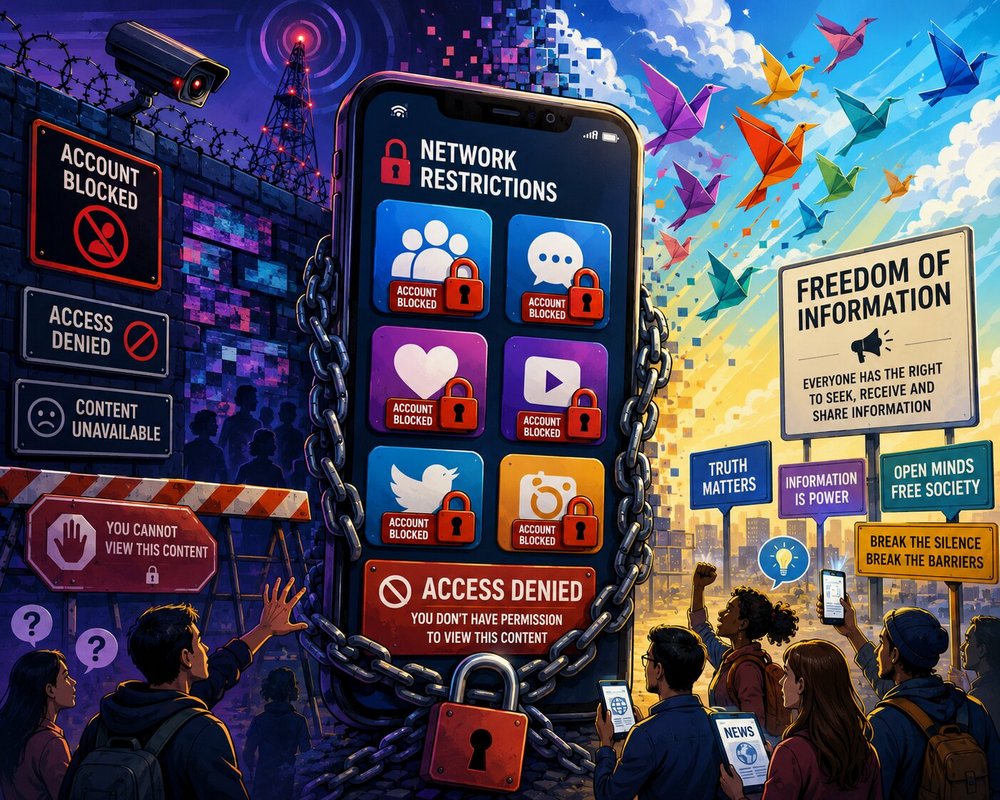
ILLUSTRATION: Generated with AI