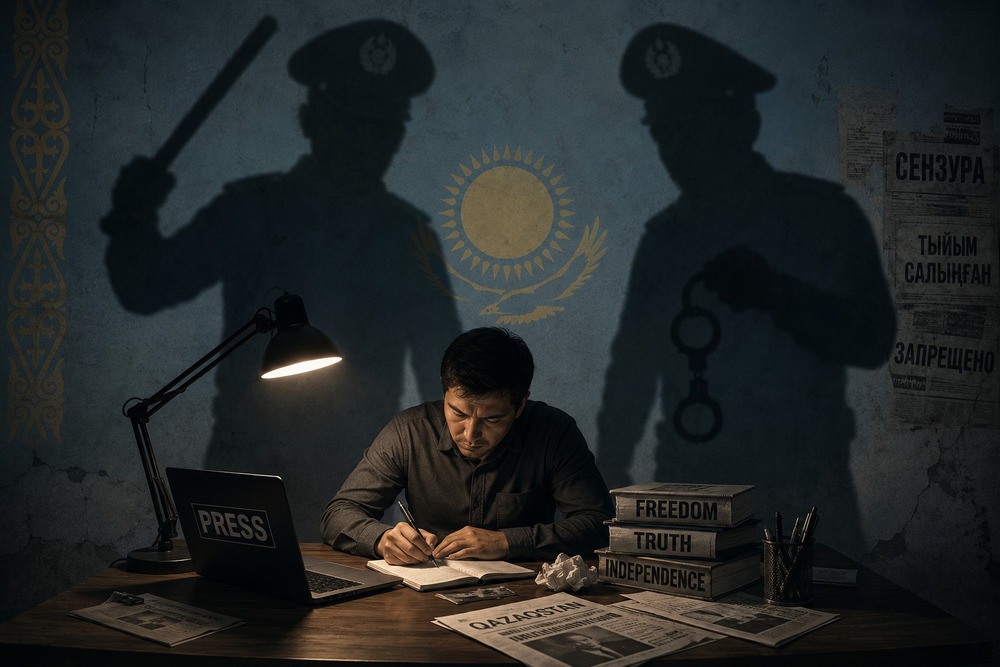
This year’s National Media Worker’s Day (28 June) will be observed against a backdrop of growing concerns about media freedom, following a number of recent incidents affecting journalists and media organizations.
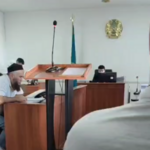
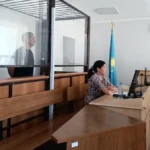
In Almaty alone, six judicial proceedings involving four journalists and three influencers are currently taking place simultaneously in different courts across the city. This influx of cases reflects the general state of journalism in Kazakhstan, which is increasingly turning into a minefield for the few remaining independent journalists. This is largely related to the Article 274 of the Criminal Code of Kazakhstan. In order to convict influencers and journalists considered inconvenient by the State, the authorities rely on this article and often do not even bother proving the alleged “falseness” of the information in question.
On 15 June, the editor-in-chief of the country’s oldest news agency KazTAG, Amir Kasenov was arrested. He has been since the end of last year charged under the now familiar Article 274 of the Criminal Code of Kazakhstan “dissemination of knowingly false information”. Case originated from a complaint filed by the management of the financial holding company Freedom Finance, which is owned by the Russian-born billionaire Ruslan Turlov. Similar charges against KazTAG director Asset Matayev were subsequently dropped, only to be immediately reopened for “hooliganism”. Now the journalist, who has been injured in a strange incident is now under house arrest awaiting trial.
Adilethan Moldakhan (a jurist with millions of views on Instagram) reported the statements of one of his respondents, raising awareness on the fatal accident that occurred in Almaty. He exposed the fact that high-ranking police officers (since then fired) protected members of Almaty’s “golden youth” while they were organizing dangerous races along the city’s avenues. Elmar Uyakhit (Husseinov) was for disseminating knowingly false information about Minister of Justice.
On 19 March, legal proceedings were initiated against activist Aijan Mameshova under this article, after she posted on social media about abuses in an orphanage, including violence against minors and restrictions of the privileges for children with disabilities.
Vadim Boreiko, the creator of the YouTube channel “Hyperborea” has become the defendant in a lawsuit filed by a construction company apparently affiliated with one of the major developers. Although Boreiko quoted verbatim in his reports the words of residents dissatisfied with the development, as well as those of the former mayor of Almaty, all the claims were directed solely at the journalist. Immediately after receiving the complaint, the court froze all of Boreyko’s bank accounts.
With regard to Gulnar Bazhkenova, editor of the online publication Orda.kz—who, in addition to charges under Article 274, was also charged with “misappropriation or embezzlement of entrusted property” and “illegal business activities”—the first hearing on the merits of the case was scheduled for June 26, but for some reason it was postponed. Meanwhile, her attorney had his license revoked for disseminating information about her case, and she will now be represented by a “public defender.”
Recently the journalist Bogatoz Omarova was forced to confess that she dissemined false information to close the criminal case that had been opened against her because of two videos she made about unpaid construction workers. She was since then put under house arrest.
“I acknowledge the fact that I disregarded the principles of reliability objectivity and impartiality as well as the fundamental principles of journalism; enshrined in the Law of Mass media. I was driven largely by a desire to attract new subscribers and generate interest I the topic among my existing audience. As a result, these publications resulted in damage to the rights, legitimate interests, and business reputation of (the company)” – she wrote in her telegram-channel. On the day the investigation into that same construction company in Kazakhstan was published, the websites of RFE/RL’s Kazakh service were blocked without a court order.
Finally, journalist Alexandra Alekhova was charged with unlawfully disseminating personal data after reporting on a dispute between market owners and vendors. Earlier, another journalist, Oleg Gusev received a three-year suspended sentence simply for including a link in his own article to Alekhova’s publication. At the time, Alekhova herself was not the subject of any criminal proceedings
Moreover, other articles commonly used to restrict freedom of expression and press such as “incitement of hatred” and “financing extremist activities” and even “obstruction of the exercise of electoral rights and obstruction of justice” have not disappeared and continue to be applied in cases that authorities consider more serious.
Meanwhile, three bloggers are serving prison sentences. Daniyar Adilbekov was sentenced to 4.5 years for posts on the “Wild Horde” Telegram channel regarding oil product shipments overseen by Deputy Minister of Energy Erlan Akkenzhenov. Mirbolat Myrzataiuly was sentenced to 4 years for “inciting ethnic hatred”; the case arose after he attempted to investigate how Chinese citizens were allegedly purchasing land plots, even though this is prohibited by law. The longest sentence—seven years in prison—was handed down to Duman Mukhammedkarim, founder of the opposition channel “NeDeidi”; he was charged with “financing extremism.”
Amid such a bleak atmosphere, where freedom of speech is inextricably linked to personal freedom, the journalistic community is marking yet another professional holiday. That said, the crackdown affects only a small number of journalists. Employees of state-run or state-supported media outlets will, as is traditional, receive cash bonuses and apartments.
In its annual Press Freedom Index, Reporters Without Borders whose assessments have repeatedly proven trustworthy over the years, ranked Kazakhstan 149th out of 180 countries. For the first time, Kazakhstan was ranked below Uzbekistan (147th). This doesn’t mean that the situation improved in Uzbekistan, rather, it illustrated how dramatically conditions have deteriorated in Kazakhstan.