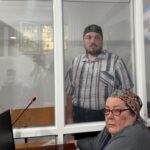
According to the information we have received, on May 18, the Specialized Interdistrict Investigative Court of the city of Almaty ruled in favor of a prosecutor-approved request from the investigator to cancel the detention in custody of Vladimir Vorontsov, and to replace it with a security measure involving placement in a specialized inpatient institution providing psychiatric care for the entire duration of the pre-trial proceedings, but for no more than one month. The ruling has not entered into legal force and has been appealed by the lawyers.
We are deeply concerned that the court made this decision without notifying either Vorontsov or his legal representatives. Neither he nor his lawyers were allowed to participate in the hearing. In our view, this constitutes a serious violation of the principle of equality and adversarial procedure of the parties in criminal proceedings guaranteed by Article 23 of the Criminal Procedure Code of the Republic of Kazakhstan (CPC RK).
The court referred to Articles 55 (paragraph 10), 56, 148 and 511–513 of the CPC RK, which, in the court’s opinion, allow the investigative judge to single-handedly make decisions, as a security measure, on transferring a person previously subjected to detention in custody to a special medical organization providing psychiatric care, keeping patients under conditions of strict isolation.
First, the court considered the issue of canceling a preventive measure, which, like issues concerning the imposition or modification of a preventive measure, must be considered with the participation of the suspect or accused and his lawyers, and, in the event of his absence (including due to mental illness), with the mandatory participation of a lawyer, as follows from paragraph 11 of the Normative Resolution of the Supreme Court of the Republic of Kazakhstan No. 1 dated January 24, 2020 “On Certain Issues of Authorizing Preventive Measures.” This requirement, however, was not observed.
Second, under Article 55(10) of the CPC RK, before ordering such a measure, the court must establish the existence of a mental illness and notify the suspect’s lawyers, who have the right under Article 56 to request a hearing with their participation. This also was not done.
In the ruling, the court referred to the conclusion of the comprehensive outpatient forensic psychiatric and narcological examination dated April 28, 2026. According to available information, this examination itself was ordered without notifying Vorontsov or his lawyers and was conducted forcibly.
This appears to violate Article 272(4) of the CPC RK, which requires that the person appointing the examination informs the suspect, the accused, and his defense counsel with the ruling appointing the forensic examination and explains their rights to them. A formal protocol documenting this process must also be prepared and signed by the person appointing the examination and the persons acquainted with the ruling. The requirements of Article 274 of the CPC RK, containing a number of guarantees of the rights of the suspect, the accused, and the defense counsel during the appointment and conduct of the examination, were also violated.
In addition, there are also serious concerns regarding compliance with Kazakhstan’s healthcare legislation. Under Article 166(5) of the Code of the Republic of Kazakhstan “On Public Health and the Healthcare System,” a psychiatric examination of a person without his consent is only permissible when there are grounds to believe that the person being examined suffers from a severe mental disorder that causes:
1) An immediate danger to himself and others;
2) Helplessness or inability independently to satisfy basic life needs in the absence of proper care;
3) A risk of substantial harm to his health due to deterioration of his mental condition if the person is left without psychiatric healthcare.
No evidence establishing any of these conditions was presented when ordering the compulsory forensic psychiatric examination.
The court’s ruling also failed to indicate compliance with the requirements of Article 509 of the CPC RK, under which compulsory medical measures may only be imposed in cases where painful mental disorders are associated with danger to oneself or others or with the risk of causing other substantial harm, as well as Article 510 of the CPC RK, according to which it is necessary to establish circumstances concerning the degree and nature of the alleged mental illness during consideration of the case.
Notably, the expert conclusion cited in the ruling contains no information whatsoever about the existence of any such danger posed by Vorontsov to himself or others. Moreover, question marks reportedly have been placed next to all diagnosed diseases, which in forensic medical and legal practice, indicates only a tentative assumption, rather than a confirmed diagnosis.
Finally, it is also important to note that proceedings in cases concerning the compulsory hospitalization of a person with a mental or behavioral disorder (disease) not related to the use of psychoactive substances in an inpatient institution providing mental healthcare are regulated by Chapter 38 of the Civil Procedure Code of the Republic of Kazakhstan (CivPC RK). This code contains a number of guarantees of the rights of such a person, including his right personally to participate in the court hearing on his compulsory hospitalization if, according to information received from the representative of the organization providing mental healthcare, the mental condition of this person allows him personally to participate in the court hearing (paragraph 1 of Article 337 of the CivPC RK), the presence of a lawyer (paragraph 1-1 of Article 337 of the CivPC RK), members of his family, and other interested persons (paragraph 2 of Article 337 of the CivPC RK).
It is difficult to assume that guarantees of the rights of such a person with respect to compulsory hospitalization may be significantly less in criminal proceedings.
Paragraph 19 of General Comment No. 35 of the UN Human Rights Committee of 2014 on Article 9 of the International Covenant on Civil and Political Rights concerning the right to liberty and security of person specifically notes that even in cases where there is confirmed evidence of serious mental illness of a person, any procedures must ensure respect for his opinion and also ensure that any representatives truly represent and protect the wishes and interests of that person.
In the UN Human Rights Committee’s decision of October 28, 2019 in the case “Zinaida Mukhortova v. Republic of Kazakhstan,” under the circumstances of which the author of the individual complaint to the Committee was repeatedly placed in closed psychiatric institutions for compulsory treatment, it was noted that the information and evidence presented by the parties did not indicate that the author posed a threat to herself or to others. In addition, the Committee expressed concern that the author had been placed in a psychiatric hospital several times despite the fact that she posed no danger to herself or others, and also indicated that involuntary detention, hospitalization, and treatment applied to her despite her objections, given that she posed no danger of causing harm to herself or others, amounted to cruel, inhuman, and degrading treatment and punishment. The Committee established a violation by the Republic of Kazakhstan of Article 7 of the International Covenant on Civil and Political Rights with regard to guarantees of the right to liberty and security of person and recommended that the state take all necessary measures to prevent similar violations in the future.
In connection with the above, we call on the authorities of Kazakhstan to:
Restore the violated rights of Vorontsov to a fair trial at the stage of pre-trial investigation, in particular, to ensure strict compliance with the principles of equality and adversarial procedure of the parties in criminal proceedings and other legislative norms concerning the rights of persons in respect of whom a decision is made on compulsory hospitalization in institutions providing psychiatric care;
Ensure that an independent forensic psychiatric examination is conducted with Vorontsov’s informed consent;
Implement the recommendations of the UN Human Rights Committee contained in the Committee’s decision of October 28, 2019 in Zinaida Mukhortova v. Republic of Kazakhstan in light of General Comment No. 35 of the UN Human Rights Committee of 2014 on Article 9 of the International Covenant on Civil and Political Rights concerning the right to liberty and security of person.
Background information: Father Iakov (Vladimir Yuryevich Vorontsov), a citizen of the Republic of Kazakhstan, was a priest of the Russian Orthodox Church of the Moscow Patriarchate in Almaty. He conducted religious services, including in the state language. He actively spoke out against Russia’s war in Ukraine and in July 2023, by decision of the Patriarch of Moscow and All Rus’, he was defrocked. For three years he unsuccessfully attempted to register an Orthodox parish of the Ecumenical Patriarchate in Constantinople, and later an independent Orthodox parish.
In December 2023, a pre-trial investigation was initiated against Vorontsov under Article 174 of the Criminal Code of the Republic of Kazakhstan (CC RK) on incitement of religious discord, which more than a year later was terminated due to the absence of corpus delicti.
In February 2026, another pre-trial investigation was initiated against him, this time under Articles 296 and 302 of the CC RK for possession of narcotics and organization of a drug den, and he was placed in custody. As of the end of May 2026, no convincing evidence supporting the suspicions brought against him had been presented, and independent observers tend to see a political motive in his persecution.