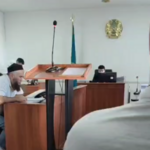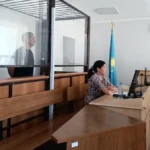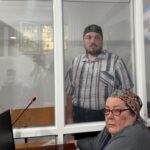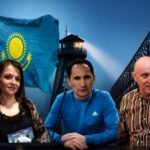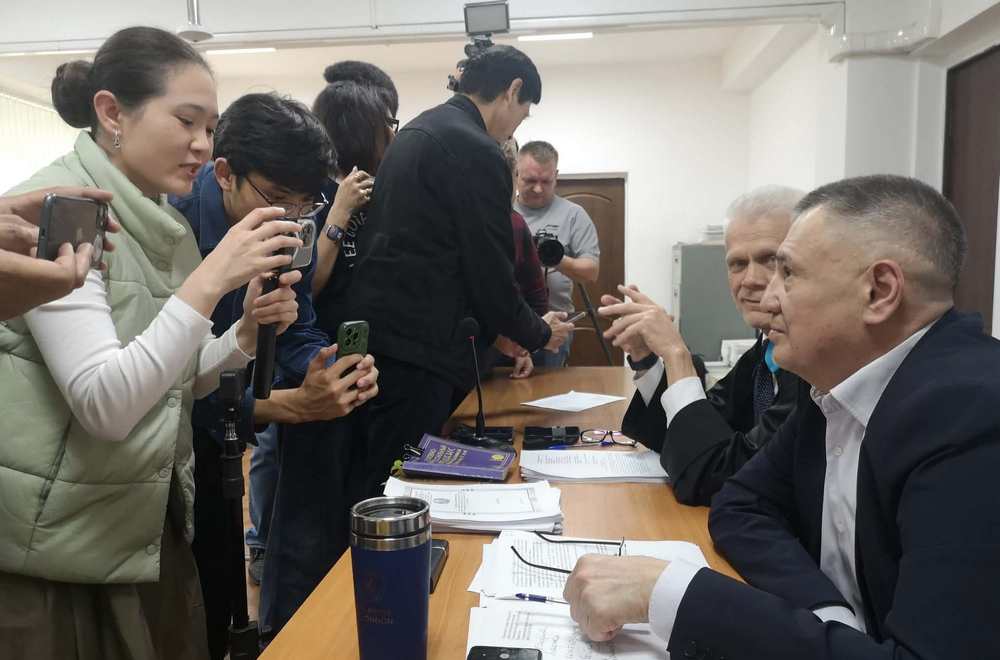
The political trial against former Vice-Minister of Finance Orazaly Erzhanov, prosecuted for calling for a boycott of the March 15 referendum on the new Constitution, began on April 28.
And not in an ordinary manner: procedural irregularities have been numerous, beginning with the appointment of the judge, which prompted defense lawyer Vitaly Voronov to request his recusal. Indeed, the presiding judge, Ruslam Muratbekov, had been “seconded” to the Almaly District Court from the Specialized Interdistrict Criminal Court of Almaty by decision of the Almaty City Court. However, cases are supposed to be assigned electronically, randomly, and only among judges of the court competent to hear the case. The audience therefore witnessed an unusual back-and-forth involving the chairman of the district court, who justified Muratbekov’s presence by citing an excessive caseload and the resulting need to bring in an outside judge, before leaving again. Should the case eventually turn in favor of the defendant, the prosecution could still appeal on the basis of these procedural violations.
The lawyer also pointed out another irregularity concerning the psychological and linguistic expert examination. According to the investigator’s order, the examination was supposed to be conducted by a single expert. Yet two experts took part, followed by two additional individuals whose professional qualifications for such a task were never clarified.
The unusual nature of this trial is also reflected in the unprecedented use of Article 150 of the Criminal Code of the Republic of Kazakhstan: “Obstruction of the free exercise by a citizen of their electoral rights or right to participate in a referendum, committed by a group of persons acting in prior conspiracy or by a criminal group.”
Arrested on February 23 over several unfortunate Facebook posts, the public figure was first placed in pre-trial detention and then transferred to house arrest the day after the Constitution was adopted. The authorities likely hoped to silence him during the three weeks allocated to the referendum campaign.
So what exactly did Orazaly Erzhanov post that so disturbed “those at the top”?
The first post explained the principle of a “smart boycott”: requesting one’s removal from the electoral rolls.
The second compared the principle of “Law and Order,” promoted by Tokayev as a guiding doctrine after the January 2022 events, with a similar concept under the Third Reich.
The defendant did not deny the facts and explained his motivation: he indeed intended to collect evidence showing that citizens refused to participate in the referendum, including requests to be removed from voter lists, and later submit this information to the Central Election Commission. “Citizens were not given the opportunity to discuss the draft Constitution,” he stated, recalling that the previous Constitution had been debated at all levels for nearly a year. Acting alone — contrary to what Article 150 implies — he used several foreign electronic SIM cards in order to bypass an impact by the state bodies on Kazakh SIM cards while collecting messages and testimonies from citizens wishing to withdraw from the voter rolls.
The prosecution witness, Valikhan Baltabayev, claimed to have “accidentally” come across Erzhanov’s posts in his social media feed. Speaking during the trial, he explained that “this could provoke dissenting opinions,” which was why he had officially requested the authorities to assess these “incomprehensible calls” from a legal perspective. Erzhanov then asked him whether he had gone to vote, to which the witness answered yes. “Did I therefore prevent you from voting? Did I obstruct the free exercise of your electoral rights or your right to participate in the referendum?” This time, the question remained unanswered.
The indictment, read aloud flawlessly by prosecutor Zhanibek Mamytov, was full of melodramatic phrases such as: “created a negative opinion in society regarding the referendum,” “promotes political non-participation,” and “poses a socially dangerous character and contributes to the growth of protest sentiments.” Yet according to the official results, nearly 73% of the population — including the prosecution witness himself — participated in the referendum vote.
The special treatment reserved for Erzhanov had in fact begun even before his arrest: the day before, he had discovered a hidden camera in the hallway of his apartment building, prompting him to call the police. His call went unanswered. However, when he was later “invited” to the police department, he was informed that his publications had displeased “those at the top.”
Orazaly Erzhanov is far from being a marginal figure in Kazakhstan: he served as Vice-Minister of Finance, Deputy Chairman of the National Bank, currently heads the Institute of Private Law at Caspian University, and chairs the “Elge Qaitaru” foundation, dedicated to returning assets allegedly stolen from the Kazakh people during the Nazarbayev era.
The next hearing is scheduled for May 13.
The debate on the new Constitution, proposed by President Tokayev in January this year, lasted just three weeks. Officially, 73 per cent of voters took part in the vote on 15 April, with 87 per cent voting in favour of the bill. However, independent observers and the OSCE ODIHR assessment mission reported a number of violations and insufficient time for discussion. Over 40 individuals and organisations faced legal consequences for criticising the bill or attempting to gauge the views of their readers. A number of experts stated that the new Constitution significantly strengthens the powers of the president and contains contradictory provisions relating to human rights.