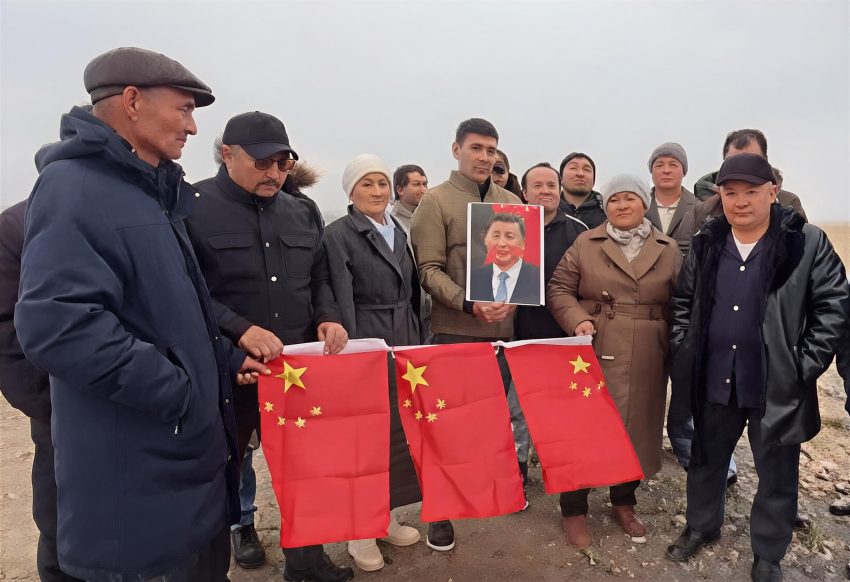
As the trial of 19 activists affiliated with the Atajurt movement nears its conclusion, International Partnership for Human Rights (IPHR) and Kazakhstan International Bureau for Human Rights and Rule of Law (KIBHR) renew their call on Kazakhstan’s authorities to drop the charges against the activists and release them.
The next hearing is scheduled for 19 March 2026, when a verdict may be announced. If convicted, the defendants could face up to ten years’ imprisonment.
The activists are facing charges of “inciting national discord” under Article 174(2) of Kazakhstan’s Criminal Code in connection with a peaceful protest held in November 2025. During the protest, they drew attention to the persecution of ethnic Kazakhs in China’s Xinjiang region, demanded the release of a fellow activist detained while travelling to China in summer 2025, and voiced concern about China’s growing political and economic influence in Kazakhstan. The protest remained peaceful throughout and included no calls for violence or hostility, although participants burned small Chinese flags and a portrait of China’s president and chanted slogans critical of the Chinese government.
“Peaceful protest – even if politically inconvenient – is not a crime,‘’ said Denis Dzhivaga, Director of KIBHR. ‘’Expressing indignation at Chinese government policies does not amount to incitement to hatred and should not lead to years behind bars.”
Initially, the activists were sentenced to short-term detention and fines for “petty hooliganism” – an administrative offence. However, after the Chinese General Consulate in Almaty issued a diplomatic note demanding that “appropriate measures” be taken in response to the protest, authorities initiated criminal proceedings.
The trial, held before the Enbekshikazakh District Court of Almaty Region, began on 23 January 2026 in the city of Taldykorgan in Zhetysu Region. After a request from one defendant citing security concerns, the court ordered the proceedings to be held behind closed doors, although the other 18 defendants were in favour of a public hearing. The closed process severely limits transparency and reinforces concerns about the fairness of the trial, with participants prohibited from disclosing details about the proceedings. Family members have had only limited opportunities to attend hearings in the capacity of public defence representatives, although the participation of such representatives is guaranteed by law. In addition, because the trial is being held several hours away from Almaty Region, where the protest took place and the activists live, participants have had to travel long distances for each hearing.
Pending the outcome of the trial, 13 activists remain in pre-trial detention while six others are under house arrest.
One of those under house arrest, Nazigul Maksutkhan, was heavily pregnant at the time of her detention and gave birth through surgical intervention on 19 February 2026. While the proceedings were postponed due to her hospitalisation, the court has refused to allow her to participate in the remaining hearings online, despite the health risks that physical attendance and travel pose for her and her newborn baby.
There are also serious concerns about the health and well-being of activists held in pre-trial detention amid reports of inadequate conditions, the deterioration of pre-existing medical issues, and lack of access to appropriate medical care. According to relatives and co-activists, Batylbek Baigazy has completely lost his eyesight, while Bakytnur Nurmukhan has suffered severe hearing loss. Tursynbek Kabiy has reportedly not received the medical assistance needed for health problems linked to torture he was allegedly subjected to in a Chinese internment camp.
Reports of psychological pressure on defendants by prison and law enforcement officials – including, in one case, alleged pressure to confess and, in others, to incriminate a co-defendant – are highly troubling and should be thoroughly investigated.
We are seriously concerned that the current case constitutes retaliation for the activists’ peaceful civic engagement in support of the rights of ethnic Kazakhs and other Turkic minorities subjected to persecution in China’s Xinjiang region. The Atajurt movement has been denied registration, and its members have faced intimidation and harassment on an ongoing basis.
“The criminal prosecution of the 19 Atajurt activists fits into a broader pattern of repression and highlights the misuse of the vaguely worded offence of ‘inciting discord’ to silence dissent. The right course now is to dismiss these charges and release the activists,” said Brigitte Dufour, Director of IPHR.
In a further worrying development, on 11 March 2026, civil society activist and Atajurt member Gulnaz Serikbayeva was detained at her home in the city of Kyzylorda, reportedly as part of an investigation under Article 174 of the Criminal Code — the same provision used against the activists currently on trial — over social media posts. While the details of the case are not known at the time of writing, this development reinforces concerns about the targeting of activists affiliated with the Atajurt movement in the context of a widening crackdown on dissent ahead of the constitutional referendum scheduled for 15 March 2026. Serikbayeva’s elderly mother reported being struck on the head by a law enforcement official in connection with the detention, necessitating an emergency medical check-up.
Activists expressing support for those on trial have also reportedly faced intimidation, including by being pressured by security and law enforcement authorities not to show up at the trial venue or to remove social media posts expressing solidarity with the defendants. In one case, a supporter was reportedly fined for “funding an unregistered organisation” (referring to Atajurt) over a small, customary gift of money given to Nazigul Maksutkhan to celebrate the birth of her baby.
IPHR and KIBHR urge Kazakhstan’s international partners to continue monitoring the case against the Atajurt activists closely, support calls for justice and their release, and insist on effective and impartial investigations into alleged violations of the rights of the defendants, their family members, co-activists and supporters. They should also demand an end to the persecution of individuals who express views that are critical of those in power or considered inconvenient and hold the Kazakhstani authorities accountable to their international obligations to safeguard freedom of expression, peaceful assembly and association.