When Guldariya Sherizat staged a protest in Kazakhstan over the arrest of her husband in neighboring China, she did not expect to end up in the dock facing 10 years in prison.
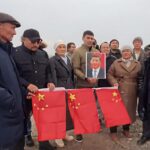
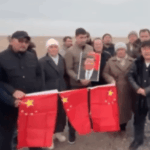
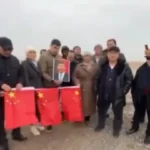
But her case came under the geopolitical spotlight after Kazakhstan’s ally, China, urged Kazakh officials to take action against 19 protesters who burned Chinese flags and a portrait of Xi Jinping, China’s paramount leader, near the Chinese-Kazakh border last November.
They are now charged with inciting ethnic discord, a criminal offense carrying a jail sentence of up to a decade.
The victim of their alleged crime, the indictment (as seen by Eurasianet) states, is the entire Chinese nation.
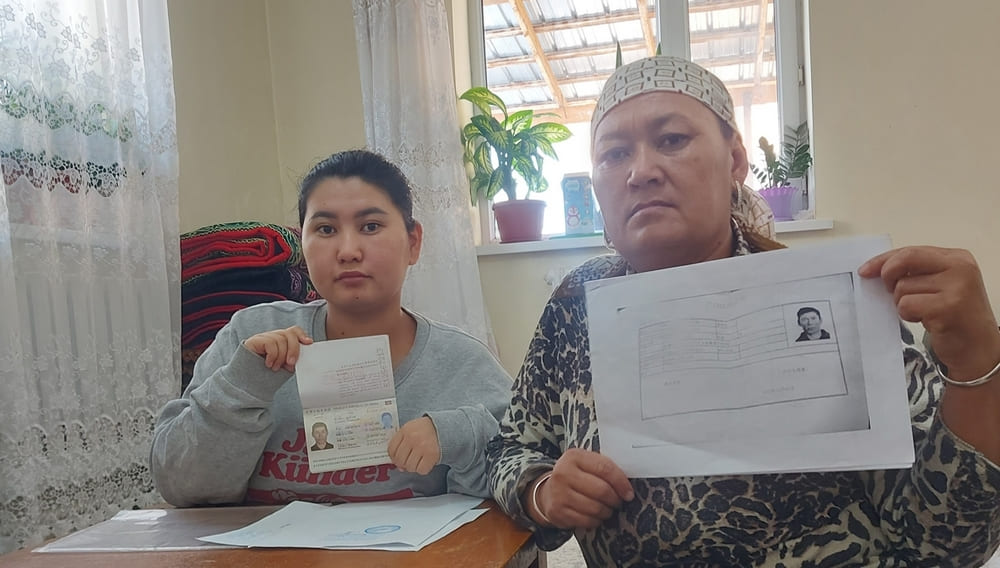
“I went out to protest with demands to free my husband because he’s not guilty of anything, yet he’s being held in a Chinese camp,” Sherizat told Eurasianet in an interview in her house in Uzynagash, a small town outside Almaty, Kazakhstan’s commercial capital.
She and five other suspects are under house arrest; the others are in detention.
“We wanted to reach the border holding Chinese flags and Xi Jinping’s portrait, but we were not allowed to proceed [by Kazakh police] so we burned them,” she explained. “We burned them to protest over why Xi Jinping is holding a Kazakh citizen.”
That citizen is Alimnur Turganbay, Sherizat’s husband. He was arrested on undisclosed charges when visiting China last year.
As well as demanding his release, the demonstrators chanted slogans like “Down with the Communist Party!” and “Down with Xi Jinping!”
They also called for an end to human rights abuses against Muslim minorities in Xinjiang, China’s westernmost province, bordering Kazakhstan. Beijing’s internment of Muslims—mainly Uighurs and Kazakhs—in “re-education camps” and suppression of their religious practices are well documented.
Shynkuat Bayzhanov, Sherizat’s lawyer, rejects the charge that the defendants were inciting enmity against the Chinese nation. This was a “political protest” against the Chinese leadership, not the Chinese people, he told Eurasianet. “They’re innocent.”
Rights groups have urged Kazakhstan to drop the case, deeming it “inconsistent with international human rights standards” protecting freedom of expression and assembly.
“Instead of aiding China’s repression, the Kazakh government should press the Chinese government to stop its crimes against humanity in Xinjiang,” suggested Human Rights Watch. Beijing denies committing human rights abuses in Xinjiang.
The 19 protesters were initially handed fines or prison terms of a few days, under administrative charges connected with staging an unauthorized public assembly.
But after China’s Foreign Ministry sent a diplomatic note (cited in the indictment) expressing “profound concern” and urging Kazakhstan’s government to take “appropriate measures,” the protesters were slapped with criminal charges of inciting discord.
The trial in the town of Taldykorgan, four hours’ drive from Almaty, began on January 23 and is taking place behind closed doors, keeping proceedings out of the public eye.
Critics see the case as appeasement to China, Kazakhstan’s geopolitical ally and major economic partner. China is Kazakhstan’s largest trade partner, points out Edward Lemon, co-author of the book Backlash: China‘s Struggle for Influence in Central Asia.
“China is also a major investor, and Kazakhstan is central to a number of trade corridors as part of China’s Belt and Road Initiative,” Lemon said.
For China, Kazakhstan is also a key supplier of oil and critical minerals.
Then there is the political quid pro quo. “Politically, China has supported Kazakhstan’s authoritarian system and defended the regime during the Bloody January protests in January 2022. In exchange, China expects silence on the situation in Xinjiang,” said Lemon.
In this trial, the defendants are Xinjiang-born Kazakhs who moved to Kazakhstan under a government scheme offering citizenship to ethnic Kazakhs living in other countries, provided they returned to their titular homeland.
Sherizat, Turgunbay and their three daughters moved in 2016 and obtained Kazakh passports in 2017, giving up their Chinese citizenship (as required under both countries’ laws).
Turgunbay, a 48-year-old truck driver, was arrested on a trip back to China last year, then handed a 2.5-year prison term on undisclosed charges. Sherizat remains in the dark about her husband’s case, having received no official communications about the charges.
ChinaAid, a non-profit group promoting religious freedom, suggests they may relate to religious activity such as praying.
Consular assistance from Kazakhstan has been complicated by China’s claim that Turgunbay remains a Chinese citizen – although his Chinese passport is stamped “cancelled”.
Neither the Chinese Embassy in Astana nor Kazakhstan’s Foreign Ministry responded to emailed requests for comment.
The trial has increased pressure inside Kazakhstan on a rights group that has long lobbied to stop abuses in Xinjiang.
The defendants include Bekzat Maksutkan, a leader of Nagyz Atajurt (Real Fatherland), who participated in November’s anti-China protest. Nagyz Atajurt collects and publishes testimony from ex-detainees of Chinese re-education camps and detainees’ relatives. Turgunbay once visited its Almaty office to record a video appeal calling for the release of his nephew, serving a 17-year prison sentence in China, allegedly for praying.
Nagyz Atajurt has been in the crosshairs in Kazakhstan since its outreach attracted global media attention as international controversy raged over abuses in Xinjiang, placing Astana in an awkward position vis-à-vis its Chinese partners.
In 2019, Kazakh police arrested the group’s leader, Serikzhan Bilash, on charges of inciting ethnic discord against the Chinese. He escaped jail with a plea bargain, pledging to halt his activism. He later moved to the United States, where he resumed lobbying for the rights of Xinjiang’s minorities.
Bilash believes the latest trial is a bid to silence his group once and for all. “The Kazakh government wants to destroy Atajurt totally, permanently,” he told Eurasianet by telephone.
In its diplomatic note, China accused the group of tarnishing the image of Xi and the Communist Party. It also accused the group of having a “negative impact” on the Sino-Kazakh alliance.
As Sherizat contemplates the prospect of jail time, she hopes Kazakhstan’s duty to protect its citizens’ rights will trump its concerns over Beijing’s sensibilities. “I believe Kazakhstan should defend its citizens even if China is a great, powerful nation,” she said.
“Will this be justice if the Chinese imprison my husband and the Kazakh state imprisons me?” she added.
SOURCE:
Eurasianet