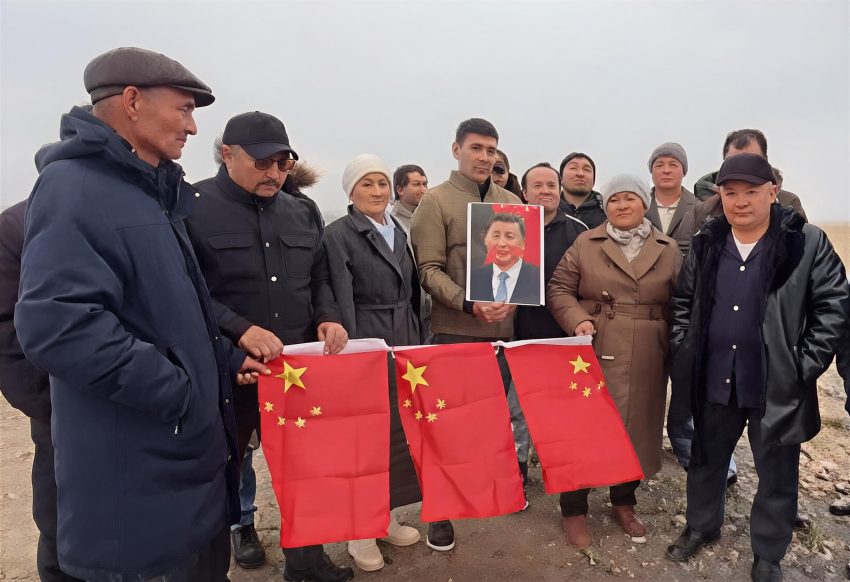
International Partnership for Human Rights (IPHR) and Kazakhstan International Bureau for Human Rights and Rule of Law (KIBHR) regret the conviction of 19 activists associated with the Atajurt movement on charges of “inciting national hatred” in Kazakhstan. The authorities should urgently review these cases and ensure that peaceful civic engagement is not criminalised.
At a final hearing held in the city of Taldykorgan on 13 April 2026, the court delivered its verdict in the case. It found the defendants guilty in relation to a peaceful protest held in November 2025 and sentenced part of them to five years in prison, while the rest received suspended sentences of a similar duration. The defendants were also banned from engaging in public or political activities for three years. The sentences of women activists with small children were deferred until their children reach the age of majority.
“The convictions in this case are a stark illustration of the misuse of criminal law to restrict the legitimate exercise of the freedoms of expression, association and assembly,” said Brigitte Dufour, IPHR Director. “Peaceful protest, even when perceived as politically sensitive or provocative, should not be treated as a criminal offence.”
The sentences issued are not yet final and can be appealed.
The charges stem from a protest during which participants highlighted the persecution of ethnic Kazakhs and other Turkic minorities in China’s Xinjiang region, called for the release of a detained co-activist, and voiced concern about China’s growing influence in Kazakhstan. Video recordings of the protest were shared on social media.
State-appointed experts engaged by the prosecution argued that the protest contained elements of inciting national hatred against Chinese people and insulting their national dignity. However, the protest focused on criticising Chinese government policies and, although participants burned small Chinese flags and a portrait of China’s president, it remained peaceful and did not involve any advocacy of discrimination, violence or hostility. It therefore falls within the scope of protected expression under international human rights law.
The broadly worded Criminal Code provision (Article 174, part 2) under which the activists were prosecuted has repeatedly been used against critical voices. Both human rights defenders and international experts have criticised its arbitrary application to restrict the legitimate exercise of fundamental freedoms – often based on questionable conclusions from state-appointed experts.
The provision in question is considered an ‘’extremist’’ offence, with those convicted under it included on an official list maintained in this context and subjected to restrictions on their financial operations. Given that Article 63 of the Criminal Code excludes the use of suspended prison sentences in ‘’extremist’’ cases, the legal basis for the sentences issued in the current case appears unclear.
It is highly troubling that the criminal charges were initiated following a Chinese diplomatic note calling for “appropriate measures” in response to the protest. This raises serious concerns that the Kazakhstani authorities yielded to external influence in criminally prosecuting the activists, after first sentencing them to short-term detention and fines for “petty hooliganism” – an administrative offence.
The court proceedings were held behind closed doors, although most defendants favoured a public hearing, and participants were barred from disclosing details. This resulted in a lack of transparency and public scrutiny, reinforcing concerns about the fairness of the trial. Reports of pressure on defendants — including allegations that coercive methods were used in attempts to obtain confessions or testimony implicating co-defendants – cast further serious doubt on its fairness.
Throughout the investigation and the trial, which began in late January 2026, 13 activists were held in pre-trial detention, while six others were under house arrest. While the protest took place in Almaty Region, where activists live, the trial was held in Taldykorgan in Zhetysu Region, requiring significant travel for participants.
While the defendants under house arrest attended the announcement of the verdict, those in pre-trial detention were connected online. At the same, a defendant in house arrest who was heavily pregnant when first detained and who gave birth in February 2026, was only allowed to attend part of the court proceedings online, despite the health risks that in-person participation posed to her and her baby.
It is of further concern that pre-existing medical conditions of several defendants have reportedly deteriorated in pre-trial detention, including of several now handed real prison terms.
The case initiated over the November protest reflects a broader pattern of pressure against the Atajurt movement, which for years has sought to expose the persecution of ethnic Kazakhs and other Turkic minorities amid China’s crackdown in Xinjiang — an issue that remains politically sensitive given Kazakhstan’s close and deepening ties with China. The movement has been denied registration and its members have faced ongoing harassment. In a separate case, another Atajurt activist is currently in detention pending investigation on similar charges related to social media posts.
“We urge the Kazakhstani authorities to cease persecuting Atajurt activists for their civic engagement,” said Yevgeniy Zhovtis, Chief Expert-Consultant of KIBHR. “They should bring Criminal Code Article 174 in line with international standards and ensure it cannot be applied to peaceful expression that does not involve advocacy of violence, hostility or discrimination.”
IPHR and KIBHR also call on Kazakhstan’s international partners to speak out against these convictions and to hold the government accountable to its international human rights obligations with respect to freedom of expression, association and assembly, as well as other fundamental rights.